Every burden you lift from healthcare professionals’ shoulders is a gain.
Yasmin Hendriks, oud-trainee
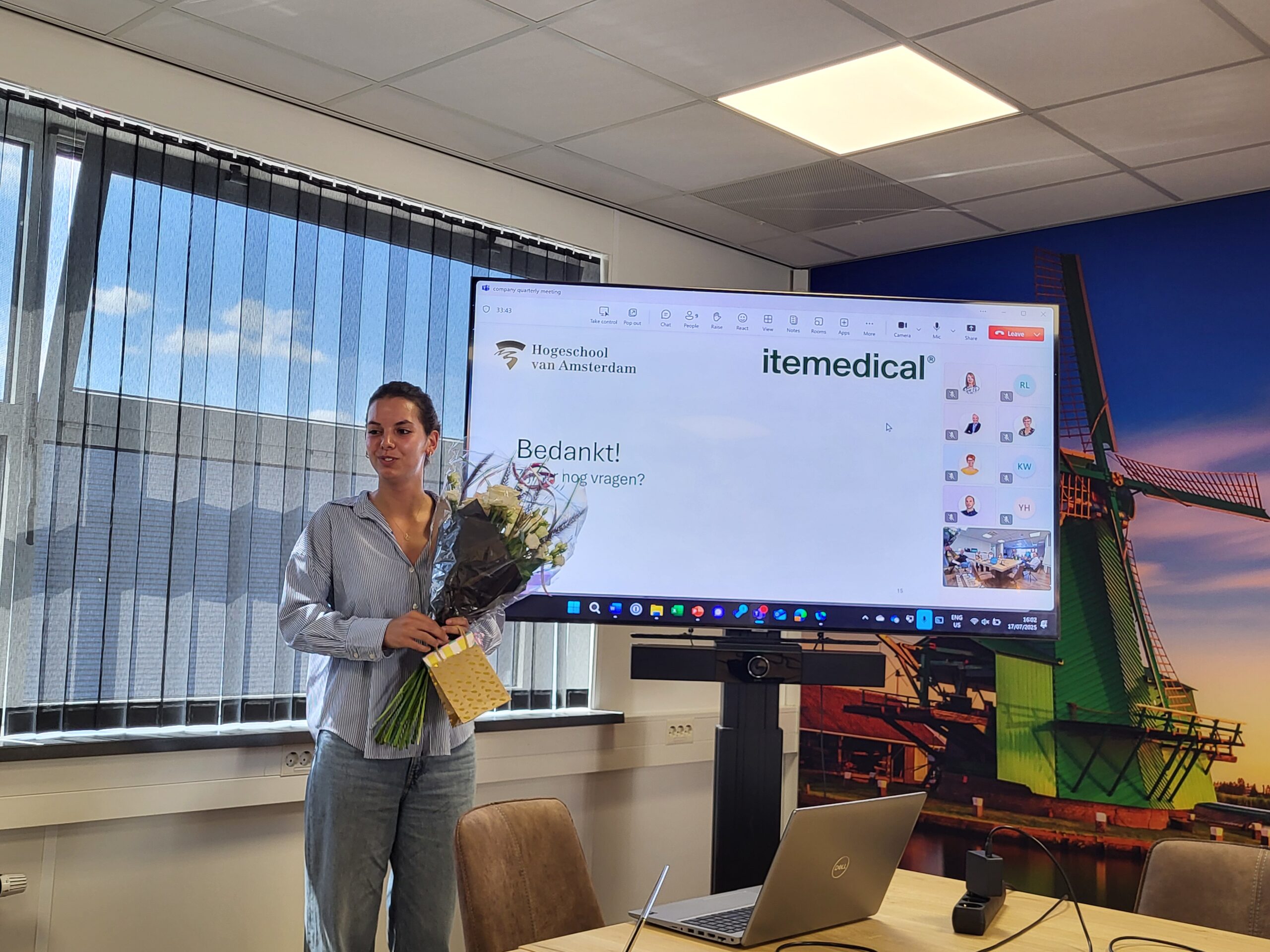
Her graduation internship at Itemedical did not follow a smooth path. It was more like a bumpy road full of twists and turns. Yet Yasmin Hendriks persevered. With determination, resilience, and a keen eye for healthcare practice, she turned her internship into a personally and professionally rewarding experience.
“Because not everything went perfectly, I learned even more—about planning, coordinating between hospitals, handling time pressure… and about healthcare practice itself,” Yasmin reflects.
From plan A to plan C
Her graduation internship took several turns. From Alrijne to Erasmus MC, and finally to UMC Groningen, where Yasmin successfully completed her research. This university hospital has been using the MDDG alarm management system since 2022. Yasmin studied the impact of this solution on two departments: the Neonatal ICU (NICU) and the Pulmonology ward D3VA.
At the last minute, she also conducted a few interviews with healthcare professionals. “Nurses reported that the alarm frequency was relatively high before the implementation,” Yasmin explains. One nurse even mentioned occasionally hearing alarms after her shift, though this was rare and mostly occurred after particularly busy days. The combination of alarm pressure and the transition to a new work environment—from an open ward to single-patient rooms—noticeably affected how they experienced their work.
What the data showed
The data analyses confirmed that impression.
- On D3VA, the number of alarms decreased by 76.8%.
- In the Neonatal ICU, the reduction was even 93%.
- The average alarm duration decreased by 8.6 seconds (30%) on D3VA.
- The number of prolonged alarms (>180 seconds) dropped significantly from 1.29 to 0.46 per day on D3VA.
Yasmin: “We also observed differences in the pattern and distribution of the alarm data. This opens up opportunities to optimize the system…”
Putting the numbers into context
In addition to the numbers, Yasmin also investigated how healthcare professionals experience the alarm management system. “I found it extremely valuable to not only look at the data but also see and hear firsthand what healthcare professionals really experience. How high the pressure and demands of care are, and how the MDDG is already contributing positively. By including their stories in my research, the numbers gained meaning.”
“From the conversations, it became clear that nurses could respond to alerts more quickly and purposefully,” Yasmin explains. They received only actionable alerts, enriched with context, which provided calm and clarity. That context helped them assess the situation more quickly. Despite a few points of attention, such as duplicate alarms, overall appreciation for the alarm management system was positive. “They felt better supported in their work.”
Practical advice for UMCG
What can departments in Groningen take from this? Based on the data and practical experience, Yasmin formulated three concrete recommendations.
- “Actively quantify alarm fatigue. For example, using a validated questionnaire. Link these insights to reductions in alarm fatigue and increased job satisfaction.”
- “Share and discuss alarm data regularly with the team. This strengthens support and helps make the impact of interventions visible.”
- “Actively involve nurses in the evaluation and further development of the alarm management system. This includes fine-tuning alarm settings, preventing duplicate alarms (monitor and phone), and adjusting the escalation chain.”
Or, as Yasmin puts it herself: “I believe that every burden we can lift from their shoulders is not only good but also important.”
Learning on the job
The visit to the Neonatology ward and the conversations with nurses about their daily experiences made a deep impression on Yasmin. “It really moved me. It showed how important it is to see technology not as an end in itself, but as a support for care. Every second of reduced noise means more space for attention.”
What Yasmin takes away
She looks back with pride at her final report and her personal growth: “I saw how dependent you are on various factors in the hospital. But also how important it is to involve nurses, to listen, and to reflect with them. That truly makes the difference in a successful implementation.”
The internship confirmed her choice to pursue the master’s in Health Economics, Policy & Law at Erasmus University Rotterdam. “Specifically to contribute to better policymaking, so that innovations like the MDDG can reach clinical practice more quickly and effectively.”
What’s next?
With her previous experience in Ghana, where she interned at a school for deaf children, Yasmin knows better than anyone how valuable basic healthcare is. “What we take for granted is far from that there. Access to good care is limited. If I can contribute in the future with the knowledge I’ve gained, that would be wonderful.”