An average 70% reduction in alarms is no small achievement. It’s huge.
Roy Donker, ICT Application Manager and member of the Alarm Management Committee, Tergooi MC, The Netherlands
What started as a technical challenge around data integration at Tergooi MC developed into a broader approach to medical alarm management. After moving to its new hospital in Hilversum, Tergooi MC wanted to send data from its new infusion pumps both to the EHR and to the alarm distribution system. However, the docking station supported only a single data stream, while replacing the docking stations would have required a substantial investment. itemedical’s Medical Device Data Gateway (MDDG) provided the technical software solution. Later, the hospital also began routing patient monitor alarms through the MDDG.
This technical foundation delivered more than just a more stable alarm chain. The MDDG also makes alarm data available for analysis, giving the hospital insight into what was actually happening throughout the alarm chain. The focus therefore shifted from “Are the alarms being transmitted correctly?” to “Which alarms really need to be sent directly to the care phone?”
That insight formed the basis for targeted alarm reduction across six departments. A small adjustment to the alarm delay produced a remarkably large effect.
Greater control over the alarm chain
For ICT, the MDDG provides greater visibility into medical devices and the alarm chain. This supports both day-to-day management and troubleshooting when a fault or interruption occurs.
“If there is a problem somewhere in the alarm chain, I can identify much more quickly where something is going wrong. Previously, it took much more time to work that out.”
From alarm data to targeted analysis
The Alarm Management Committee identified that large numbers of medical alarms were being sent to clinical staff. Using alarm data from six departments, itemedical’s alarm coach analysed where opportunities for optimisation existed and modelled the potential impact of different delays on low-priority alarms.
The analysis is carried out separately for each department, as alarm profiles, volumes and types of alarms differ between areas such as the ICU, CCU and paediatric departments. The alarm coach therefore advises each department on targeted optimisation opportunities, while also drawing on experience from other hospitals. This comparison gave the Alarm Management Committee additional guidance when assessing the possibilities for introducing alarm delays. “That comparison is very useful. We don’t necessarily want to be the first hospital to introduce something.”
If you know that an adjustment is working well in another hospital, it gives you the confidence to take that step yourself.
“We looked at how much the number of alarms would decrease with a delay of five, ten or fifteen seconds. The figures were very promising, so we decided to take the next step.”
For this first step, Tergooi MC chose to apply the same configuration across the hospital.
The Alarm Management Committee decides
The data provides direction, but the Alarm Management Committee decides which adjustments Tergooi MC implements. The committee includes representatives from ICT, clinical physics, medical technology, nursing, team coordinators and a medical specialist. “The alarm chain crosses different disciplines. ICT plays a role, medical technology does too, but ultimately it is the clinical staff who work with it. So you need each other.”
The committee reviews the analysis, considers the clinical impact and decides which changes can be introduced safely and responsibly in clinical practice.
Small adjustment, major impact
The Alarm Management Committee deliberately chose a manageable first step: a five-second delay on low-priority alarms. Following previous issues within the alarm chain, the committee considered it important to maintain trust and support among the clinical departments.
“We wanted to make a change where everyone involved could say: this is responsible and this is safe. That’s why we started small.”
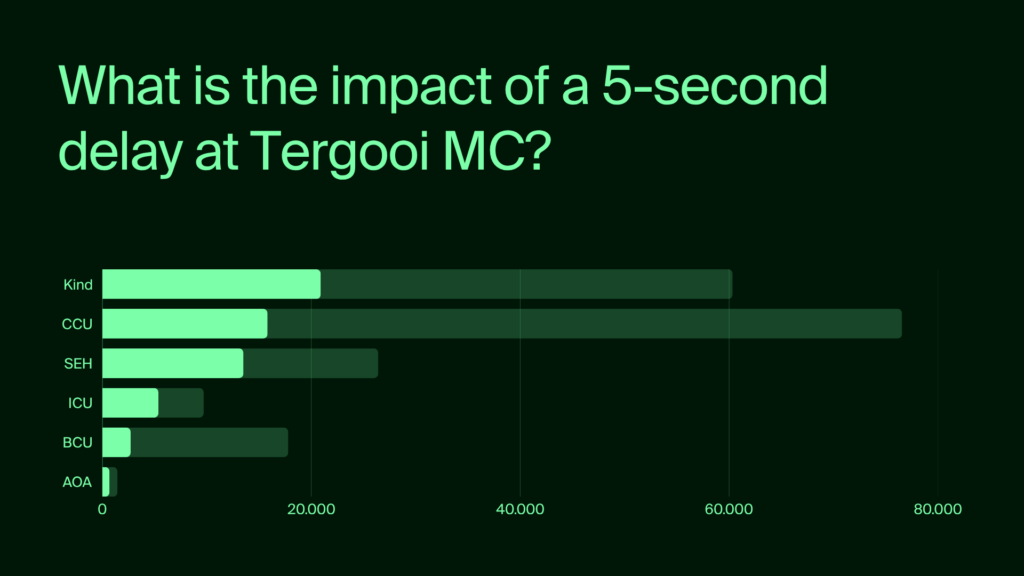
The figures from June and July show a clear effect for each department before and after introducing the five-second delay.
Previously, the six departments registered 192,235 low-priority alarms. After the delay was introduced, 58,968 alarms reached the care phone. That means 133,267 fewer alarms were forwarded over a period of two months — an average reduction of 69%.
Making the difference visible
The reduction is not always immediately noticeable in everyday clinical practice. “If you ask the clinical staff, they say: I think I’m receiving quite a lot fewer alarms. But that very quickly becomes the new normal.” That is precisely why objective alarm data is so valuable: it makes the effect visible.
Continuing step by step
For the Alarm Management Committee, alarm optimisation does not end with this first adjustment. Periodic analysis of alarm data reveals new patterns and further opportunities for optimisation. As part of this process, the alarm coach supports the hospital with data analysis and advice. The Alarm Management Committee remains in control and determines which adjustments can be implemented safely and responsibly in clinical practice. Roy also values the direct communication with the itemedical team, both during the analysis and when questions arise about the MDDG.
This creates a continuous improvement cycle: analyse → assess → adjust → measure again
“We want to review this periodically and ask ourselves: how can we take the next step from here?” Roy explains.
Roy also appreciates the direct contact with the itemedical team, both during the analysis and when questions arise about the MDDG.
Look at the entire alarm chain
Roy has one main piece of advice for other hospitals: look at medical alarm management as a whole and involve all the disciplines that play a role within the alarm chain.
The MDDG really is the connecting link for me. It gives you much better insight into what your are doing as a whole. You can see what you are doing and what it delivers.
At Tergooi MC, it started with reliable medical device data integration. Today, that same foundation provides the starting point for targeted alarm reduction and further optimisation of the alarm chain.